
Revenue Strategy
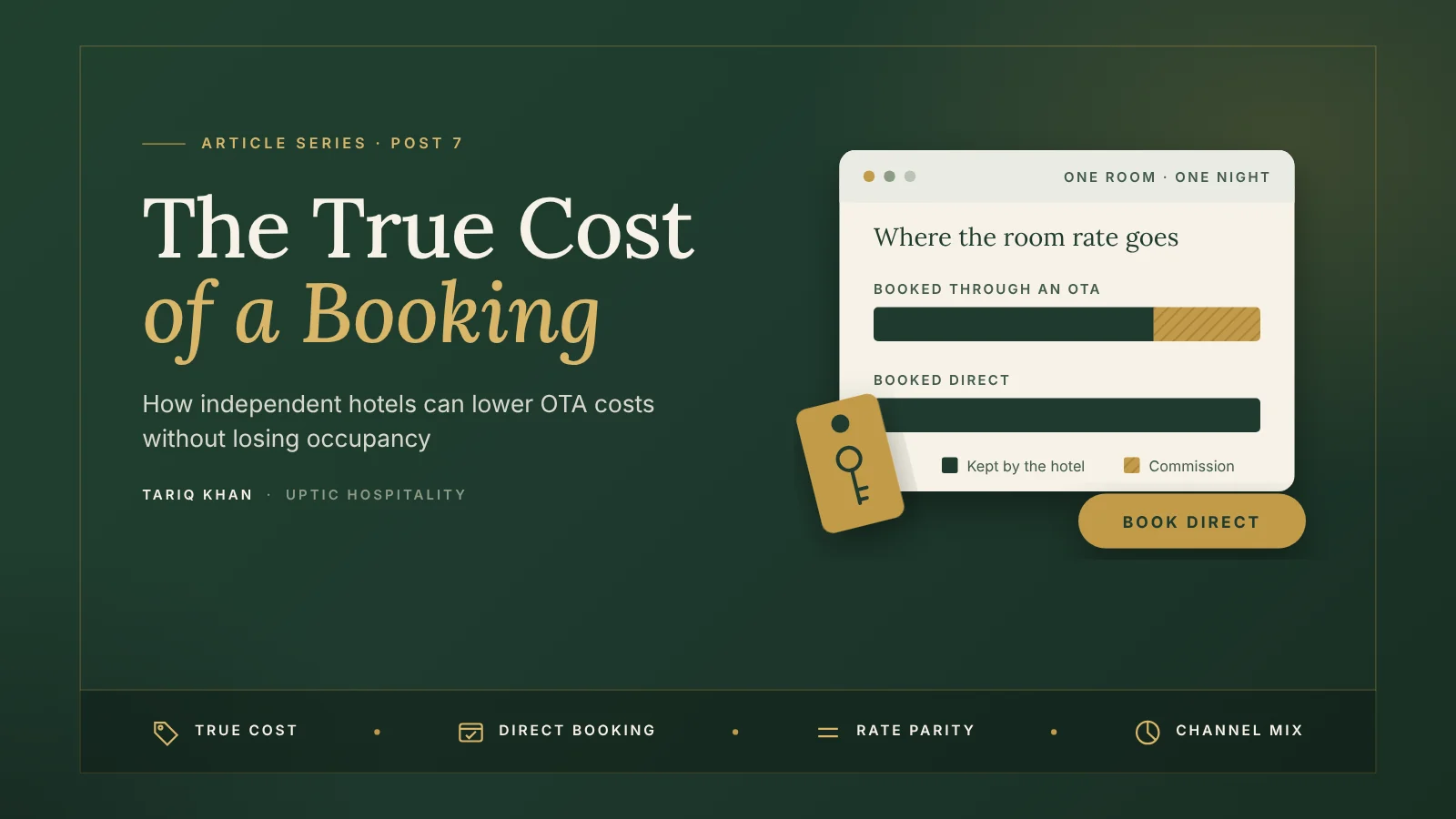
Online travel agencies fill rooms. The question is how much each of those rooms really costs, and whether the hotel is choosing that cost or simply accepting it.
An OTA booking is not a bad booking. An OTA booking the guest would have made directly is an expensive one.
Every independent hotel I know has a complicated relationship with the online travel agencies. On one hand, they bring visibility we could never buy on our own. A traveler in London or São Paulo searching for a room in New York may never have heard of our hotel, and within seconds an OTA puts us in front of them.
On the other hand, that visibility comes with a price. Commissions are commonly in the range of 15 to 25 percent of the room revenue, and often more once visibility programs and promotions are added. On a busy night, that can mean that several rooms’ worth of revenue leaves the hotel before a single guest has checked in.
The answer is not to turn the OTAs off. I have never seen that work for an independent hotel. The answer is to understand the true cost of each booking and to manage the channel mix with the same discipline we apply to rates and occupancy.
01Know What a Booking Really Costs
Many hotels look at OTA commission as a single line on the monthly statement. That number is useful, but it does not tell the whole story. To understand what a booking really costs, management should look at it per channel and per stay.
- The commission rate, including any visibility or loyalty programs
- Payment and processing costs, which differ between OTA-collected and hotel-collected bookings
- Cancellation and no-show patterns by channel
- Average length of stay and average daily rate by channel
- How often the guest returns, and through which channel
When these numbers are placed side by side, the picture usually changes. A channel with a lower commission may bring more cancellations. A channel with a higher commission may bring longer stays during the nights the hotel needs them most.
The goal is not the lowest commission. The goal is the highest net revenue.
02Use the OTAs Where They Add the Most Value
OTAs are most valuable when they reach guests the hotel could not reach on its own: international travelers, first-time visitors, and dates when demand is soft. They are least valuable when they simply sit between the hotel and a guest who was already looking for it.
This is why I think of the OTAs as a partner for reach, not a replacement for the hotel’s own sales effort. Used well, the relationship can be very productive. In my own experience, a closer and better-managed partnership with Booking.com contributed to a 21 percent increase in sales. That did not happen by accepting every default setting. It happened by working the extranet, keeping content accurate, understanding the account manager’s programs, and choosing the right ones for the right periods.
A practical approach is to open the OTAs fully during low-demand periods, use their promotions selectively when pace falls behind, and protect more inventory for direct channels when demand is strong and guests are likely to book anyway.
03Make the Direct Booking the Easiest Choice
Many travelers find a hotel on an OTA and then visit the hotel’s website before they book. This is the moment that matters. If the website is slow, confusing, or shows a higher price, the guest goes back to the OTA, and the hotel pays commission on a booking it could have kept.
A direct booking should feel like the natural choice, not a sacrifice. That means:
- A booking engine that works well on a mobile phone, with the total price shown clearly
- The same or better rate than the OTAs, within the terms of the hotel’s agreements
- A simple, genuine reason to book direct: flexible cancellation, a better room choice, early check-in when available, or a small welcome touch
- Clear room descriptions, current photographs, and policies that match what the OTAs show
- A way to reach a real person quickly, by phone, email, or messaging
None of these require a large budget. They require attention. The hotel’s own website should always be the most complete, accurate, and welcoming place to book.
The guest who finds you on an OTA and then visits your website is telling you something. Make it easy for them to stay.
04Rate Parity Is a Daily Discipline
Few things damage direct bookings faster than a guest finding a lower price on an OTA than on the hotel’s own website. Sometimes this happens through a promotion the hotel forgot it had joined. Sometimes it happens through third-party resellers or a mapping error in the channel manager.
Whatever the cause, the guest only sees one thing: the hotel’s website is not the best place to book. Management should check rates across the main channels regularly, on both desktop and mobile, and correct differences quickly. Rate parity is not a one-time setup. It is a daily discipline, just like checking the arrivals list.
05Turn Every OTA Guest Into a Future Direct Guest
An OTA can introduce a guest to the hotel once. What happens during the stay decides where that guest books next time.
The front desk plays an important role here. A warm welcome, accurate information, a room that matches the photographs, and a sincere invitation to book directly on the next visit can change the guest’s habits. A short note at check-out, a business card with the website, or a thoughtful follow-up email where permitted can all help the next reservation come through the hotel’s own channel.
This is where revenue strategy and guest experience meet. The best way to lower acquisition costs over time is to give guests a reason to come back to you directly.
06Review the Channel Mix Every Month
Channel mix should be reviewed with the same regularity as occupancy, ADR, and RevPAR. Each month, management can ask a few simple questions:
- What share of room revenue came direct, and what share through each OTA?
- What did each channel cost in commission and fees?
- Which OTA bookings came on dates when the hotel would likely have filled anyway?
- Which promotions or programs actually produced additional business?
- Is the direct share moving in the right direction?
Small, steady improvements matter. Moving even a few percentage points of business from OTA to direct can make a meaningful difference to the hotel’s net revenue over a full year, without losing a single room night.
A Lesson From My Hospitality Experience
Over my years in independent hotels, I have learned that OTA costs are rarely a problem of the OTAs alone. More often, they are the result of small gaps: a website that does not convert, rates that drift out of parity, a booking engine that frustrates guests on a phone, or a front desk that never invites the guest back directly.
When those gaps are closed, the OTAs return to the role they do best: bringing new guests the hotel could not reach on its own. The hotel keeps the visibility and gains more control over its revenue.
Distribution is where this matters most, especially with the largest OTAs, such as Booking.com and Expedia. They bring tremendous reach, but in my experience rate parity and availability issues are also most common with them, and they need daily attention.
When deciding how to balance direct bookings and OTAs, I have found that working with a few smaller OTAs alongside the major ones can reduce much of that daily stress, while still bringing guests the hotel would not reach on its own.
The OTAs will remain an important part of hotel distribution. Independent hotels do not need to choose between visibility and profitability. With clear numbers, a strong website, consistent rates, and a team that turns first-time guests into returning ones, they can have both.
If you would like a quick sense of what OTA commissions cost your hotel each year, our free OTA commission calculator takes about two minutes.
Which channel brings your hotel its most valuable guests, and do you know what each one really costs?
A free first look
If any of this sounds like your hotel, I’ll take a look at it—the website, the rates, the guest journey—and send you three clear observations. No cost. No obligation.
Request your free first look →