
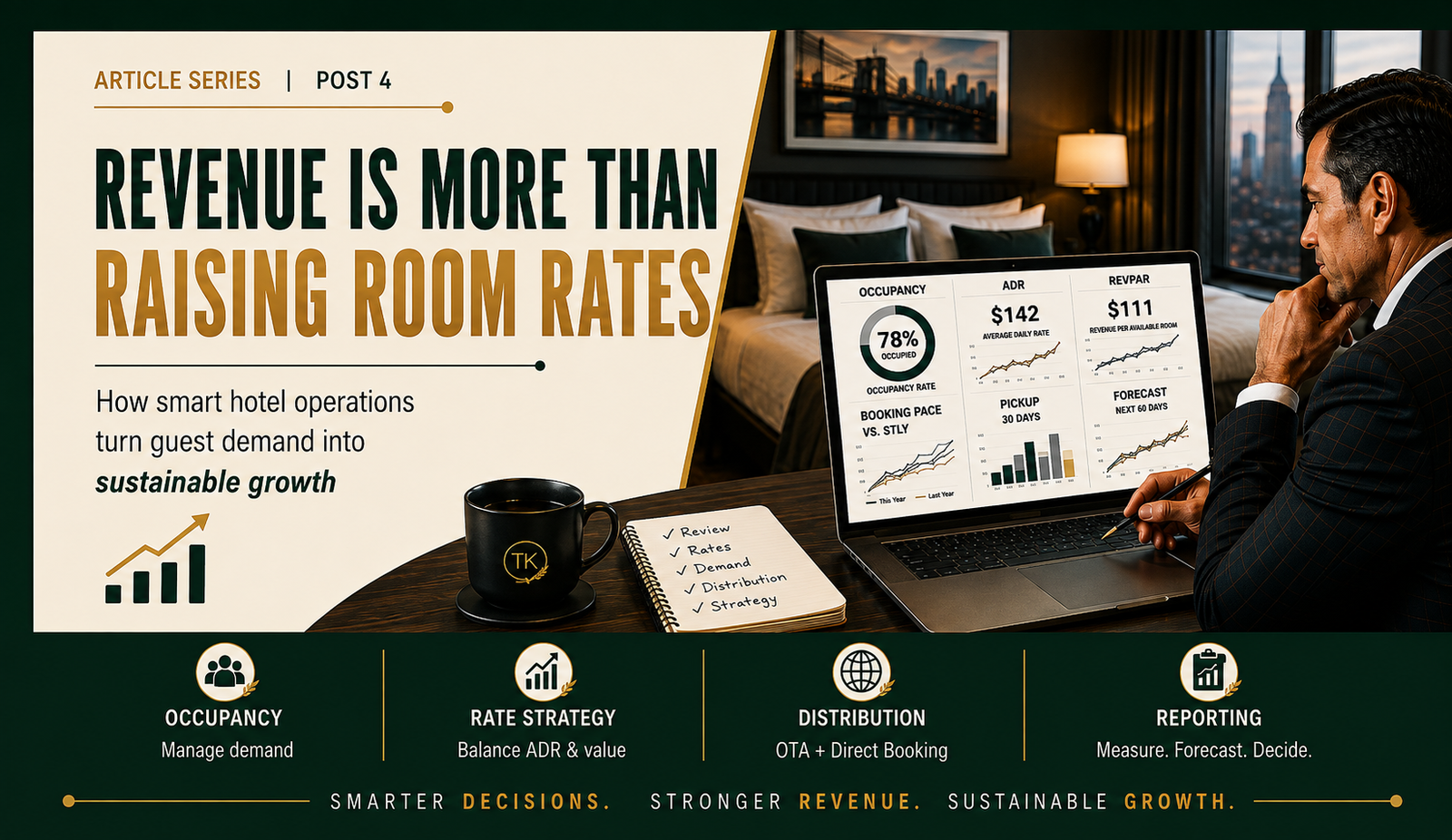
How smart hotel operations turn guest demand into sustainable growth.
After more than 20 years in hospitality, I have learned that successful revenue management is not simply about raising room rates. It is about understanding the business well enough to recognize an opportunity—and knowing when to act.
A higher room rate may look impressive on a report, but an empty room generates no room revenue. At the same time, filling every room too early or at the wrong rate does not necessarily mean we have maximized the hotel’s revenue potential.
For me, revenue management begins with occupancy, but it certainly does not end there. I want to understand how quickly reservations are building, how much time remains before arrival, what demand looks like in the market, which distribution channels are producing business, what those reservations cost us to acquire, and how much inventory remains. Together, those pieces help answer one important question: What should we do today to improve the revenue opportunity ahead of us?
01Occupancy Is Where My Revenue Strategy Begins
Over the years, I have developed my own occupancy checkpoints. I pay particular attention when occupancy reaches approximately 20%, 40%, 60%, 70%, 80%, and 90% or above. These percentages are not an industry formula; they are checkpoints I have developed through experience. Each time occupancy moves through one of these levels, I reassess the business.
At lower occupancy levels, my focus is naturally on generating reservations. Are our rates positioned correctly? Are we visible on all appropriate channels? Is the hotel website producing direct business? As occupancy moves through 60% and 70%, I pay closer attention to booking pace, remaining inventory, days until arrival and expected demand. At 80%, 90% and above, the remaining rooms become increasingly valuable if demand continues to support them, and it may be time to protect rate, reduce unnecessary discounts or become more selective about distribution.
A hotel can be full and still have missed a revenue opportunity if too much inventory was sold too early or too cheaply. Holding an unrealistic rate while rooms remain empty can be equally costly. A hotel room is perishable inventory; once tonight passes, an unsold room can never be recovered. Successful occupancy management is about balancing occupancy, Average Daily Rate (ADR), and Revenue per Available Room (RevPAR) while continuously responding to demand.
I have learned not to celebrate high occupancy until I understand how we achieved it.
02Booking Pace, Forecasting and the Uncertainty of Hospitality
Occupancy tells me where the hotel stands, while booking pace tells me where it may be heading. For this reason, I watch my occupancy checkpoints carefully and compare them with how quickly future reservations are developing. Looking 7, 14, 30, 60 or 90 days ahead can provide a very different picture from simply looking at tonight’s occupancy.
If a future period is approaching 70% occupancy and reservations are arriving faster than expected, there may be no reason to stimulate additional demand with unnecessary discounts; the opportunity may instead be to protect inventory and strengthen the rate. If that same period is sitting at 40% and reservations are arriving more slowly than expected, I may need to review rates, increase visibility, strengthen distribution or find another way to generate demand.
Hospitality is inherently uncertain. Seasonality, weather, holidays, citywide events, economic conditions, cancellations, competitor behavior and unexpected events can change demand quickly. No forecast will predict everything perfectly, but forecasting gives management something extremely valuable: time to respond. Recognizing a potentially weak period 30 days in advance gives us far more options than discovering it three days before arrival.
03Rate Strategy: Know When to Hold and When to Adjust
Revenue management is sometimes reduced to constantly changing room rates, but I see it differently. Rate strategy should respond to demand, booking pace, remaining inventory, time to arrival and market conditions. During high demand, lowering rates simply because competitors are doing so may sacrifice revenue unnecessarily. During a weak period, holding a rate the market is unwilling to accept can leave valuable inventory unsold.
Understanding the market is important. I want to know what comparable hotels are charging, what events are taking place, whether the market is experiencing compression, and how demand is developing. But every hotel has its own product, location, reputation, guest mix and value proposition. Competitive information should help us understand the market—not run our hotel for us.
The objective is to recognize when the market gives us permission to push the rate and when conditions tell us that stimulating demand may produce the better result. ADR and RevPAR help measure that balance, but experience helps interpret what those numbers are telling us.
04Distribution: Use the OTAs, but Strengthen Your Own Website
Online Travel Agencies are an important part of today’s hotel revenue strategy. They provide enormous visibility, expose independent hotels to travelers around the world, and can generate reservations from guests who might never have discovered the property otherwise. I believe in utilizing appropriate OTAs and allowing them to do what they do very well: generate reach and demand.
But distribution comes with a cost. A $200 reservation booked directly and a $200 reservation arriving through an OTA may produce the same ADR, but they do not necessarily produce the same net revenue after commission and acquisition costs. This is why I strongly believe every hotel should work toward having a self-sufficient website with a reliable direct-booking capability.
A hotel website should not simply be an online brochure. Guests should be able to discover the property, understand the rooms, see accurate photographs and information, check real-time availability and rates, and confidently complete a reservation directly. The objective is not to eliminate OTAs; it is to create the right business mix—using third-party distribution when it adds value while strengthening direct business, reducing avoidable acquisition costs and building a guest relationship the hotel can own.
05Reports Should Lead Somewhere
I have always believed strongly in reviewing hotel performance daily, weekly, monthly and quarterly, but reports should never exist simply because management is expected to produce them. Each reporting period should answer a different question and ultimately help us decide what to do next.
Daily, I want to understand what needs attention now: occupancy, pickup, cancellations, rates, remaining inventory and immediate opportunities. Weekly, I look at how future business is developing and where the strong periods or gaps are. Monthly, I review whether our decisions worked through occupancy, ADR, RevPAR, room revenue and distribution. Quarterly, I step away from individual dates and look for larger patterns that should influence future strategy.
Forecast accuracy is part of that learning process. If we expected 85% occupancy and finished at 65%, why? If we expected a weak period and finished much stronger, what did we miss? The purpose is not to criticize the forecast; it is to make the next forecast better. One report provides numbers, but consistent reporting reveals patterns, and patterns support more confident decisions.
06Technology Is Powerful, but Revenue Is Ultimately About Profitability
Revenue-management technology has become increasingly sophisticated. Revenue Management Systems can process historical performance, booking pace, competitor pricing, demand patterns and other information much faster than any individual manager. Larger hotels may have dedicated revenue teams, while independent properties may rely more heavily on the General Manager, sales team, ownership or outside revenue specialists.
I see technology as an advantage, not a replacement for management experience. The strongest revenue strategy combines technology, data, market knowledge and operational experience. A system may identify an opportunity a manager could miss, but an experienced operator also understands the property’s physical product, guest expectations, operational challenges, reputation and long-term objectives.
Revenue management also has to connect with profitability. Generating additional revenue is important, but OTA commissions, promotions, credit-card fees and other acquisition costs affect what the hotel ultimately keeps. That is why I like to ask not only how much revenue we generated, but how effectively we generated it.
07The Final Decision Still Belongs to Management
This is where everything comes together. Occupancy tells us where we stand. Booking pace tells us where we may be heading. Forecasting gives us time. Market information provides context. ADR and RevPAR help measure performance. Distribution tells us where the business is coming from and what it may cost. Reports reveal patterns, and technology helps process the information.
But none of those things makes the final decision by itself. Management still has to decide whether to increase or protect the rate, stimulate demand, remove a discount, adjust availability, strengthen a particular channel, push direct bookings, or leave the strategy exactly as it is because the numbers tell us it is working.
There is a particular satisfaction in watching a period that initially looked challenging begin to turn around. Reservations start arriving, occupancy moves through the checkpoints, rates strengthen, the business mix improves, and decisions made days or weeks earlier begin to appear in the results. For me, that is what makes revenue management interesting. It is not one rate change or one occupancy report; it is a series of informed decisions, made at the right time, that collectively improve the performance of the hotel.
Revenue is more than raising room rates. It is about understanding your business well enough to recognize an opportunity, having the information to evaluate it, and having the confidence to act on it.
The numbers provide direction. Management judgment turns that direction into a decision.
What revenue-management strategy has made the biggest difference at your property? I would be interested to hear what has worked for you.
A free first look
If any of this sounds like your hotel, I’ll take a look at it—the website, the rates, the guest journey—and send you three clear observations. No cost. No obligation.
Request your free first look →