

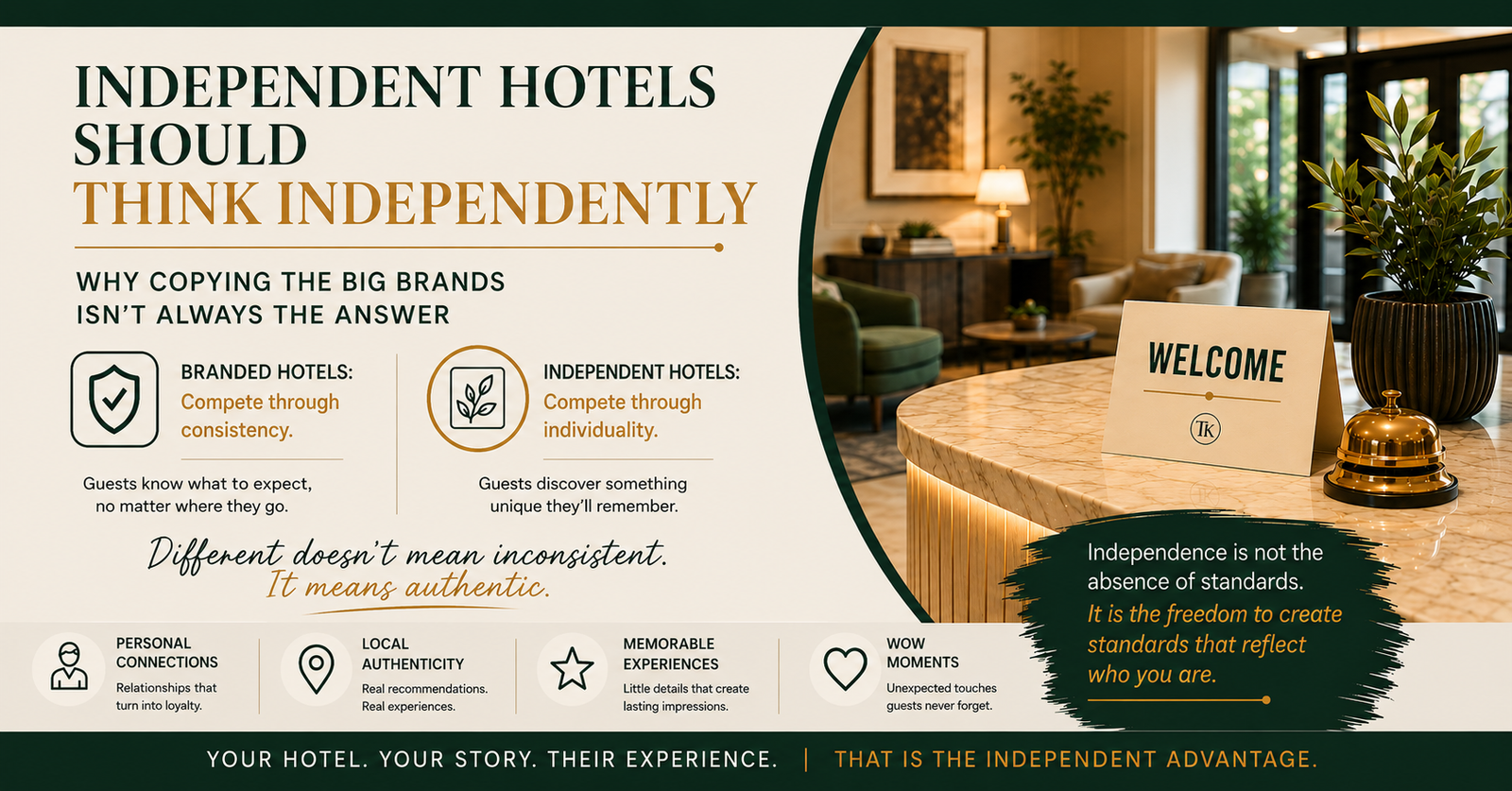
Why individuality can become an independent hotel’s greatest advantage.
Independent hotels have always had a unique opportunity to present themselves differently. Unlike large hotel brands, they are not required to fit every property into the same mold. Their building, neighborhood, history, people, and personality can all become part of the guest experience. That individuality gives guests an opportunity to discover something they may not find anywhere else.
Branded hotels, on the other hand, have built much of their success around consistency and predictability. A guest recognizes the brand and often arrives with expectations already established. Room standards, amenities, service procedures, and even the overall feeling of the stay may be familiar before the guest walks through the door.
There is real value in that consistency. It creates confidence. But independent hotels have an opportunity to compete in a very different way.
01The Same Hamburger Effect
Hospitality, in my opinion, is deeply connected to the feeling of being at home. It is about creating a place of comfort—a welcoming atmosphere, a relaxing environment, and a sense that, even while away from home, you can settle in and feel at ease.
And at the end of it all, there is something very simple but essential: a comfortable place to sleep.
In today’s branded hospitality, much of the guest experience is built around familiarity. I think of this as the hamburger effect.
Think about McDonald’s. Sometimes all it takes is seeing those big golden arches on a billboard to know what is ahead. You recognize the symbol, you recognize the brand, and you already have an expectation of the experience before you even arrive. It may satisfy your hunger. Whether it is good for your health—well, that is a discussion for another day.
Then comes the hamburger. Part of the strength of the brand is that customers generally know what to expect regardless of which location they visit. The hamburger is familiar, no matter where you order it. Consistency is part of the promise—and recognition helps bring people through the door, or even through the drive-through.
Large hotel brands are not so different. Their name and logo can create that same sense of recognition. They have the ability to create the feeling of one brand across many locations. The look, the standards, and even some of the emotions associated with the experience are intentionally familiar. Guests often choose them precisely because they know what they are likely to receive.
But should an independent hotel try to serve the same hamburger?
I don’t think so.
Independent hotels should certainly learn from the discipline, systems, technology, and consistency of successful brands. But copying the branded experience too closely can remove the very individuality that gives an independent property its reason to be chosen.
There is value in being different. And there is something powerful about having the freedom to be independent.
Brands compete through consistency. Independent hotels can compete through individuality.
02Comfort in Familiarity, Fulfillment in Discovery
Life is not only about repeating what we already know. Some of our most fulfilling experiences come from discovering new places, meeting different people, trying something unfamiliar, and seeing life from another perspective.
Travel itself is often driven by that curiosity. We leave our normal surroundings because we want to experience something different.
The same can be true of hospitality. Familiarity and routine have value. They provide comfort and confidence, and there are times when that is exactly what a traveler wants. But an independent hotel can offer another possibility: discovery.
When individuality is supported by thoughtful service and dependable operations, the guest can discover an experience they could not have completely predicted before arriving.
03The Opportunity to Create a “Wow” Moment
An independent hotel may not have the recognition, loyalty program, purchasing power, or corporate resources of a major brand. But it has something equally valuable: the freedom to create its own identity.
Guests may arrive without every expectation written in stone. When the hotel gets the experience right, that creates room to surprise them.
A “wow” moment does not always require an expensive renovation, luxury amenity, or elaborate gesture. Sometimes it comes from a team member remembering a returning guest, offering a thoughtful local recommendation, solving a problem creatively, or simply making someone feel that they are staying somewhere with a personality rather than somewhere created from a template.
That human connection is difficult to standardize, and for an independent hotel, it can become one of its greatest strengths.
04Two Different Hospitality Possibilities
05Independence Does Not Mean the Absence of Standards
Being independent does not mean operating without standards. In fact, independent hotels may need strong standards even more, precisely because there is no corporate system behind them to protect the guest experience.
Rooms still need to be clean. Information must be accurate. Reservations must be handled properly. Service must be dependable. Rates must make sense. Teams must communicate. Guests must be able to trust what the hotel promises.
The difference is that standards should support the hotel’s character rather than erase it.
Independence is not the absence of standards. It is the freedom to create standards that reflect who you are.
06Independent Thinking
My years in independent hospitality have taught me that we should learn from the large brands without trying to become smaller versions of them.
We can learn from their discipline, systems, technology, revenue strategies, and consistency. But we should also understand what makes an independent property worth choosing in the first place.
Independent thinking means looking at the hotel in front of you—the guests you serve, the team you have, the neighborhood around you, and the opportunities available to you—and making decisions that fit that hotel.
That ability to think differently can influence everything: how we welcome a guest, how we present the hotel online, how we manage revenue, how we solve problems, and how we create experiences guests remember.
A branded hotel can give a traveler the comfort of knowing what to expect. An independent hotel, when managed well, can give them something else: the pleasure of discovering something they did not expect.
And sometimes, that unexpected moment is exactly what brings a guest back.
What do you believe gives independent hotels their greatest advantage over the large brands?
A free first look
If any of this sounds like your hotel, I’ll take a look at it—the website, the rates, the guest journey—and send you three clear observations. No cost. No obligation.
Request your free first look →