

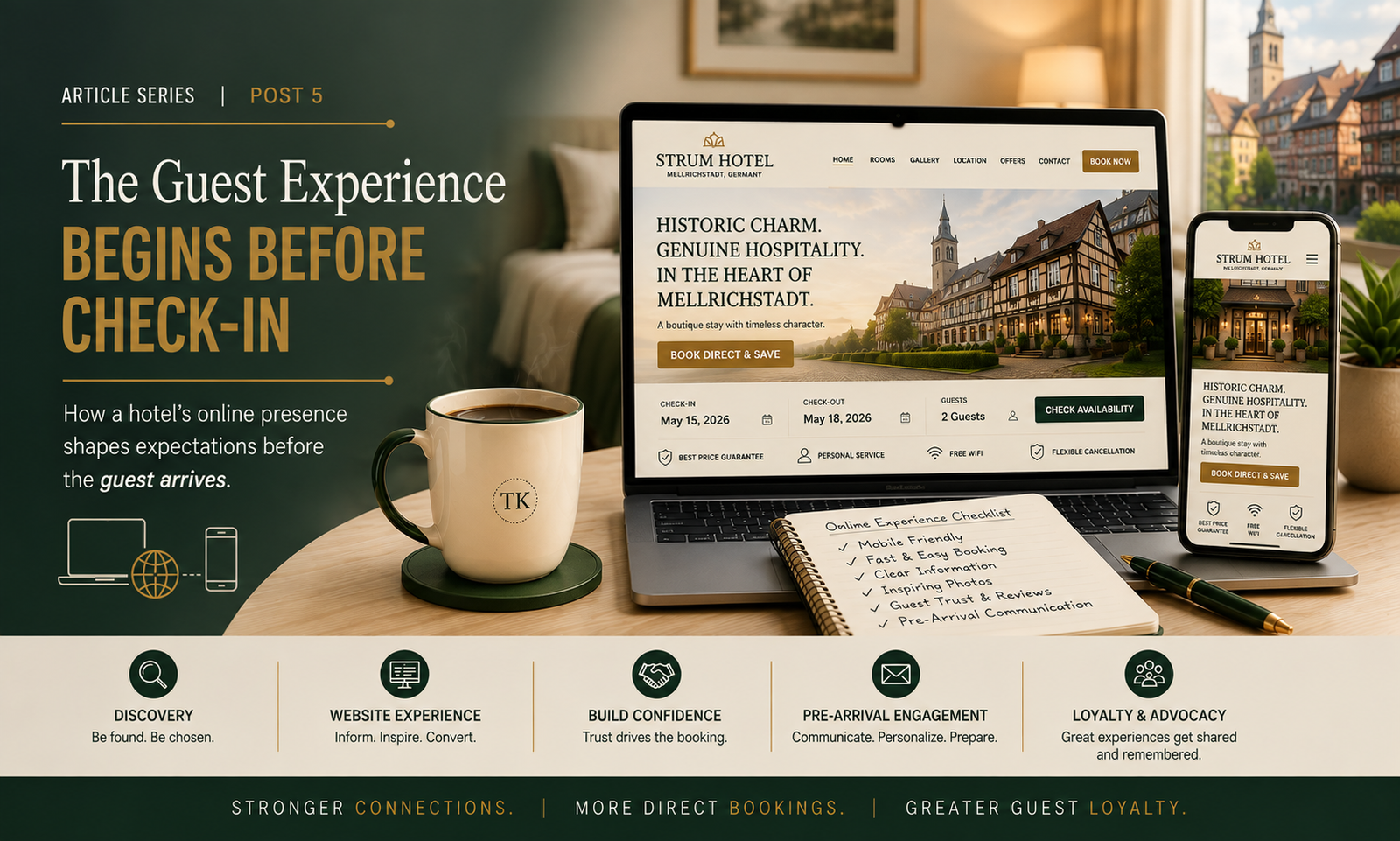
How a hotel’s online presence shapes expectations before the guest arrives.
Hospitality has traditionally been associated with a warm welcome at the front desk, a clean room, attentive service, and a helpful team—all working together to create a memorable guest experience.
The guest experience doesn’t begin when someone walks through the hotel door. Today, it often begins the moment they find you online.
However, before a hotel has the opportunity to welcome a guest in person, another important part of the journey has already taken place: the guest’s travel-planning and decision-making process.
This journey begins when travelers select a destination, choose a preferred location, and search for a hotel that best matches their needs, expectations, and budget. They compare room rates, examine photographs, read reviews, explore amenities, study hotel policies, and evaluate the surrounding neighborhood.
Long before guests arrive at the front desk, they are already forming an opinion about the hotel through its online presence. During this process, they are deciding whether the hotel feels professional, trustworthy, comfortable, and welcoming.
This is why the guest experience does not begin at check-in—it begins with the first online search.
The digital welcome should feel as dependable as the welcome at the front desk.
01The Online Search Is the First Point of Contact
A guest may discover a hotel through a Google search, an online travel agency (OTA), social media, a friend’s recommendation, or the hotel’s own website. Wherever the journey begins, the information guests find should be accurate and consistent across every digital platform.
The hotel’s name, address, telephone number, room descriptions, photographs, amenities, policies, and pricing should all align. When guests encounter conflicting information, uncertainty begins. One website may advertise an amenity that another says is unavailable. Check-in times may differ, or a room description may fail to explain the bedding arrangements clearly.
These details may appear small, but they directly influence trust—an essential part of a guest’s decision-making process. If the information is inconsistent before booking, guests may begin to question what else could be inaccurate.
Hotel management should therefore review every online listing regularly—not only the hotel’s main website. Outdated or incorrect information can create unrealistic expectations, lead to disappointment, and eventually become a front-desk problem.
A consistent online presence does more than prevent confusion. It reassures guests that the hotel is attentive, dependable, and prepared to deliver what it promises.
02The Hotel Website: Turning Curiosity Into Confidence
A hotel’s website is often the first place where the hotel has complete control over its message, presentation, and guest experience. It should do more than display attractive photographs and room rates. It should answer the questions travelers naturally have, build confidence in the property, and make the reservation process feel simple, accurate, and secure.
An effective hotel website should include
- Clear descriptions of the hotel and every room type
- Current and realistic photographs
- Amenities and services offered
- Check-in and check-out times
- Payment and cancellation policies
- Hotel address and contact information
- Transportation and parking information
- Accessibility information
- Local attractions and neighborhood guidance
- A secure and easy-to-use booking system
The website must also perform properly on mobile phones and tablets. Travelers increasingly research hotels, compare options, check rates, and make reservations from mobile devices. If a website loads slowly, contains broken links, hides important information, or makes booking unnecessarily complicated, the hotel risks losing the guest before having the opportunity to welcome them.
For independent hotels especially, I believe the website should answer as many questions as possible before the traveler needs to call or email the property. The easier it is for guests to understand what they are booking—and feel confident about that decision—the easier it becomes to turn their interest into a reservation.
A hotel website should not leave the guest with more questions. It should give them the confidence to book.
A well-designed website should ultimately communicate the same qualities we expect from the hotel itself: organization, accuracy, dependability, and hospitality.
03Photographs Create Expectations
Hotel photography is one of the most powerful aspects of the online guest experience. It offers a visual understanding that helps solve the mystery of whether or not to book a hotel room.
Guests want to understand what the rooms, lobby, building, bathrooms, and surrounding area actually look like. Good photographs can create excitement, but they must also remain honest.
Wide-angle photographs, excessive editing, or outdated images may create a wow effect, but they can also create disappointment when the guest arrives with great expectations.
The goal should not be to make the property appear to be something it is not. The goal should be to present the hotel’s genuine strengths in the best possible way. Professional and accurate photographs help guests select the right room and arrive with realistic expectations.
Beautiful photographs attract attention, but honest photographs build trust.
04Room Descriptions Must Be Specific
A picture cannot answer every question. Room descriptions should clearly explain the bed type, approximate room size, maximum occupancy, bathroom arrangement, available amenities, and any other important feature.
Terms such as “double room,” “standard room,” or “deluxe room” may mean different things at different hotels. If the description is unclear, a guest may reserve a room that does not meet their needs.
This is especially important for families, international travelers, older guests, and people with accessibility requirements. Clear descriptions reduce reservation mistakes and prevent difficult conversations at check-in.
05Pricing Must Be Transparent
Guests appreciate competitive prices, but they also value transparency. The total cost should be easy to understand before the reservation is completed. Taxes, deposits, cancellation terms, resort or facility fees, and other charges should be disclosed clearly.
A guest who believes they reserved one price but discovers unexpected charges at arrival may immediately lose confidence in the hotel. Transparent pricing does more than prevent complaints. It communicates respect.
Revenue management and guest experience must work together. A successful hotel should generate revenue without making guests feel misled.
06OTAs and the Hotel Website Should Work Together
Online travel agencies are valuable because they provide visibility and introduce hotels to travelers around the world. However, the hotel’s own website should remain the most complete and reliable source of information about the property.
A strong direct-booking strategy gives the hotel greater control over communication, strengthens the guest relationship, and can reduce commission expenses. This does not mean ignoring online travel agencies. It means using them to expand the hotel’s reach while continuously improving the hotel’s own website and reservation process.
Whichever channel the guest chooses, the room information, policies, rates, and availability should remain consistent. Otherwise, not only the guest but the OTAs will raise rate-parity concerns.
07Reviews Are Part of the Guest Experience
Many guests read reviews before they even visit the hotel’s website. They are not only evaluating the comments left by previous guests. They are also observing how management responds. A thoughtful response to a positive review shows appreciation. A professional response to a complaint demonstrates that the hotel listens and takes responsibility.
Defensive or generic responses can damage confidence. A calm and personalized response can show future guests that management cares about service recovery.
Reviews should also be treated as operational information. If several guests mention the same issue—such as noise, cleanliness, slow check-in, unclear directions, or weak communication—management should look for the cause and take corrective action. Online reputation is not only a marketing responsibility. It is a management responsibility.
Reviews tell us what guests experienced; leadership determines what happens next.
08The Booking Process Should Be Simple
Once a guest decides to reserve, the booking process should be straightforward. The guest should be able to:
- Select the correct dates
- Compare available room types
- Understand the total price
- Review the policies
- Enter payment information securely
- Receive immediate confirmation
A confusing booking system can cause abandoned reservations, duplicate bookings, incorrect room selections, and unnecessary calls to the hotel. Hotels should test their own booking process regularly from both a computer and a mobile phone. Management should experience the reservation journey from the guest’s point of view.
09Communication Should Continue After the Reservation
The online guest experience does not end when the confirmation number is issued. A clear confirmation email should include the reservation dates, room type, number of guests, total price, payment terms, cancellation policy, and hotel contact information.
Before arrival, the hotel can send a helpful message containing:
- Check-in and check-out times
- Directions to the property
- Transportation and parking information
- Identification and payment requirements
- Luggage-storage information
- Important hotel policies
- Neighborhood recommendations
- A direct way to contact the front desk
This communication reduces uncertainty and gives guests an opportunity to correct any misunderstanding before they arrive. It also helps the hotel prepare for special requests, late arrivals, accessibility needs, or changes in travel plans.
A short and helpful pre-arrival message can make the guest feel recognized before anyone has met them in person.
10Online Promises Must Match the Hotel Experience
The strongest website and best photography cannot compensate for an experience that does not match what was promised. If the website describes personalized service, the staff must deliver it. If the property advertises cleanliness, the rooms must reflect that standard. If the hotel promotes convenience, the reservation and check-in processes should not be unnecessarily difficult.
Marketing creates the expectation. Operations must fulfill it.
For this reason, the online presence should not be managed separately from hotel operations. The website, reservations team, revenue strategy, front desk, housekeeping department, and management team should all communicate consistently.
A Lesson From My Hospitality Experience
Throughout my years managing an independent hotel, I have learned that many challenges appearing at the front desk actually begin long before the guest arrives.
Unlike large hotel brands with extensive corporate support systems, independent hotels must carefully manage every part of the guest journey. The website, reservation process, online information, guest communication, and daily operations cannot function as separate pieces. They must work together to create one consistent experience.
An unclear room description can become a room-assignment concern. An outdated policy can become confusion about payment or cancellation. An inaccurate photograph can create disappointment at arrival. A poorly written confirmation can lead to unnecessary questions and frustration for both the guest and the hotel team.
These experiences have shaped the way I view hospitality. Every online detail creates an expectation, and every operational decision either strengthens or weakens the guest’s confidence.
When online information is accurate and communication is clear, guests arrive better prepared and more confident. The front-desk team can focus on what hospitality is truly about—welcoming guests, creating connections, and delivering a memorable experience.
My independent hotel experience has taught me that technology and hospitality are not separate. Technology should prepare the way, but people complete the experience.
11Technology Should Support Hospitality
Technology should never replace personal service. A website cannot offer a sincere smile. A booking engine cannot recognize a returning guest in the lobby. An automated message cannot completely replace thoughtful human communication. But technology can prepare the way for those moments.
It can answer basic questions, reduce uncertainty, help guests choose the right room, and allow the hotel team to concentrate on meaningful service. The guest journey may begin with a screen, but it should already feel personal, professional, and welcoming.
A hotel should ask itself: does our online presence accurately represent the experience we are prepared to deliver?
Because the first impression is no longer created only at the front desk.
Where does your hotel’s guest journey really begin—and does everything the traveler finds online say the same thing?
A free first look
If any of this sounds like your hotel, I’ll take a look at it—the website, the rates, the guest journey—and send you three clear observations. No cost. No obligation.
Request your free first look →